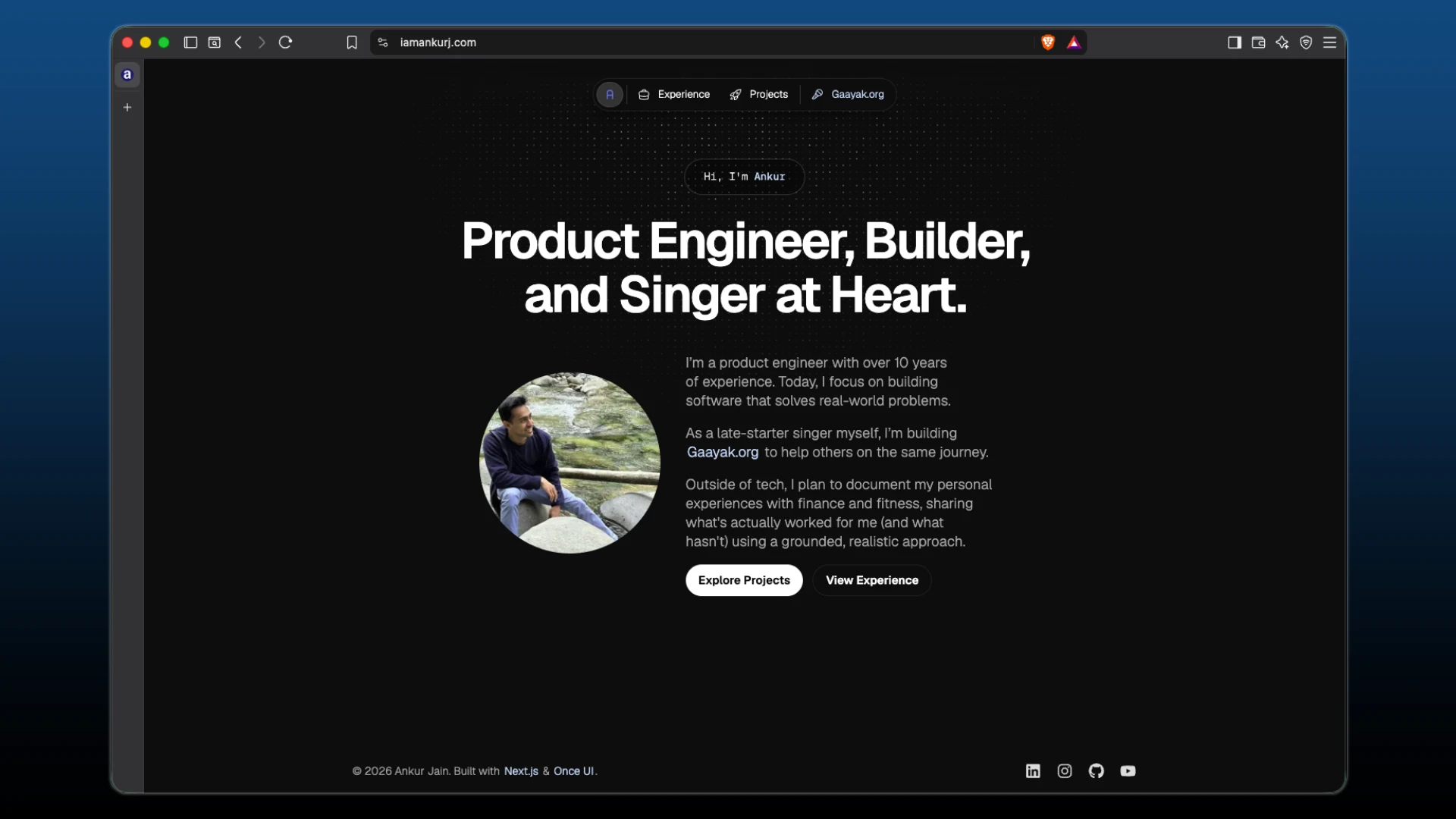
Overview
- Present experience and projects as credible engineering work, not a résumé dump.
- Make adding a project as cheap as dropping a Markdown file: no CMS, no deploy ceremony beyond git.
- Keep the content layer portable so the same files can feed another Next.js app (for example MUI) later.
- Namespace tech under /tech/* so other pillars can grow at the root without URL collisions.
Architecture & System Design
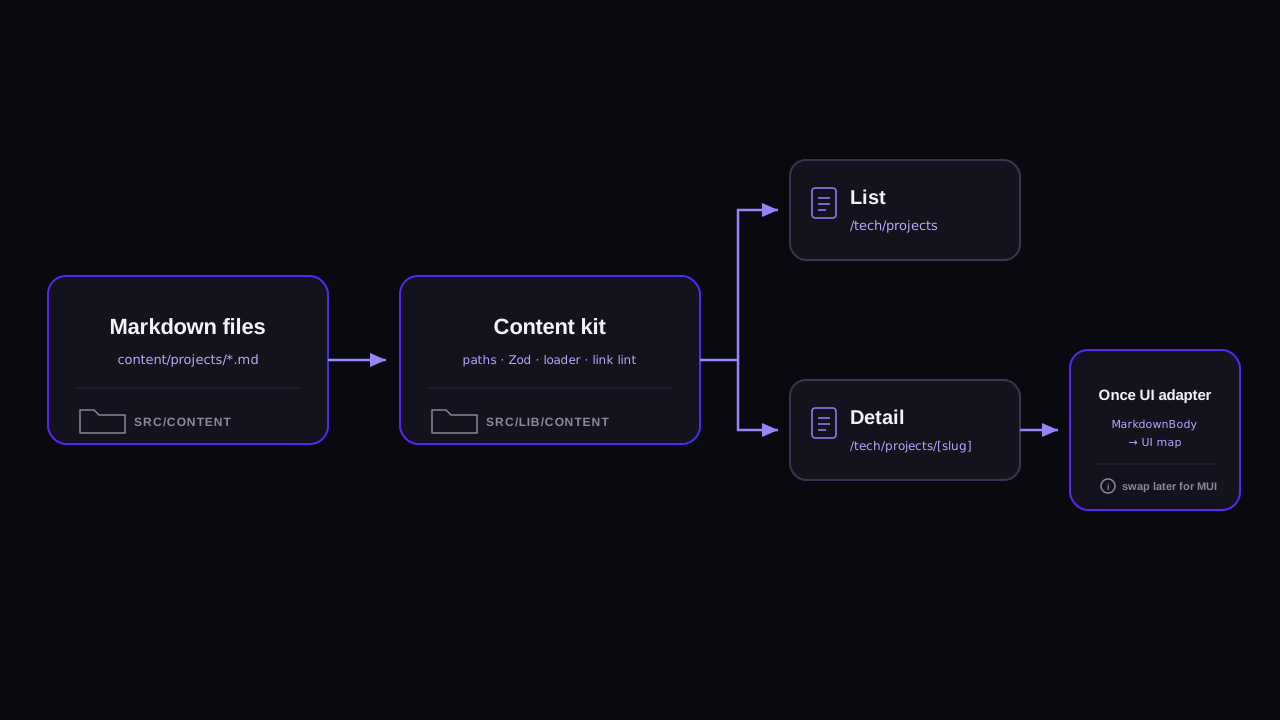
- Routing / IA: App Router with root layout.tsx. Tech surfaces live at /tech/experience and /tech/projects (plus [slug]). Content folders are not mirrored under app/. URL namespace ≠ filesystem namespace.
- Content kit: getCollection / getEntry read .md via fs + gray-matter, validate frontmatter with Zod, derive slug from the filename, sort by publishedAt, and honor draft (omitted in production).
- Link contract: On-site markdown links must be root-relative (/tech/...). Relative .md paths and dangerous URL schemes fail at load time so bad authoring does not ship quietly.
- Rendering: Plain Markdown + GFM mapped to Once UI. Layout chrome (title, date, external CTA) stays in React pages, not in the markdown file. Multiple frontmatter images use a carousel; a single image stays a simple media frame.
- Experience data: Career timeline and testimonials remain structured TypeScript for nested content; projects use markdown because case studies are long-form and change independently.
Tech Stack & Rationale
Engineering Trade-offs
- Markdown over MDX for case studies. MDX would allow custom React mid-article, but it couples content to this UI kit and complicates reuse elsewhere. Interactive UI stays in route components; prose stays portable. Upgrade path: same body string, different renderer.
- Filesystem content over a CMS. For a single author, git + Markdown is the workflow. The cost is no non-dev editing UI. The gain is versioning, PR review, and no vendor lock-in. Zod and link lint replace CMS “required fields” with build-time guarantees.
- /tech prefix now, not later. Renaming routes after SEO and inbound links exist is expensive. Establishing /tech/experience and /tech/projects early keeps other pillars free at the root and keeps engineering as one brand pillar, not the whole site.
- Once UI as accelerator, not identity. A system ships faster and keeps density consistent. The risk is a template look. Mitigations: restrained composition, content-driven project pages, and a content kit that is not Once-specific so the site can evolve visually without rewriting every case study.
- Drafts via frontmatter. draft: true keeps WIP next to published files. Production omits drafts; local/dev can still preview. Simpler than a separate drafts tree until there are multiple authors.
Key Features
- File → page pipeline: Add content/projects/<slug>.md → list card + /tech/projects/<slug> after build (see Projects).
- Typed frontmatter: title, summary, publishedAt, order, images, link, and draft validated before a page can render.
- Case study chrome + body split: Metadata drives cards, SEO, and CTAs; Markdown owns narrative depth.
- Multi-image carousel: One image renders as a single frame; two or more use a carousel on list and detail.
- Safe linking rules: Root-relative on-site paths; absolute https:// / mailto: off-site; reject filesystem-style .md links at load.
- Experience surface: Structured Experience timeline and testimonials alongside projects.
Outcome
- Home, experience, and projects list/detail under the intended URLs.
- A portable content pipeline with validation, link linting, and SSG project pages.
- This case study as a live example of the same format future projects will use.
- Additional product case studies (including CourseCorrect) on the same template.
- Extend the same loader to /fitness and /finance when those pillars are ready.